What Is Probate? The Court Process After a Death
Probate is the court process that puts someone in charge of a dead person's property, makes sure valid debts are paid and hands the rest to the right people. Whether an estate needs it, and how long and expensive it is, depends almost entirely on the state.
What probate does
A court appoints a personal representative — called an executor when a will names them, an administrator when it does not. The appointment comes as "letters" (letters testamentary or letters of administration), which banks and title offices accept as proof of authority. The representative then gathers the assets, gives notice to creditors, pays valid claims and expenses, and distributes what is left.
The three ways states let small estates skip it
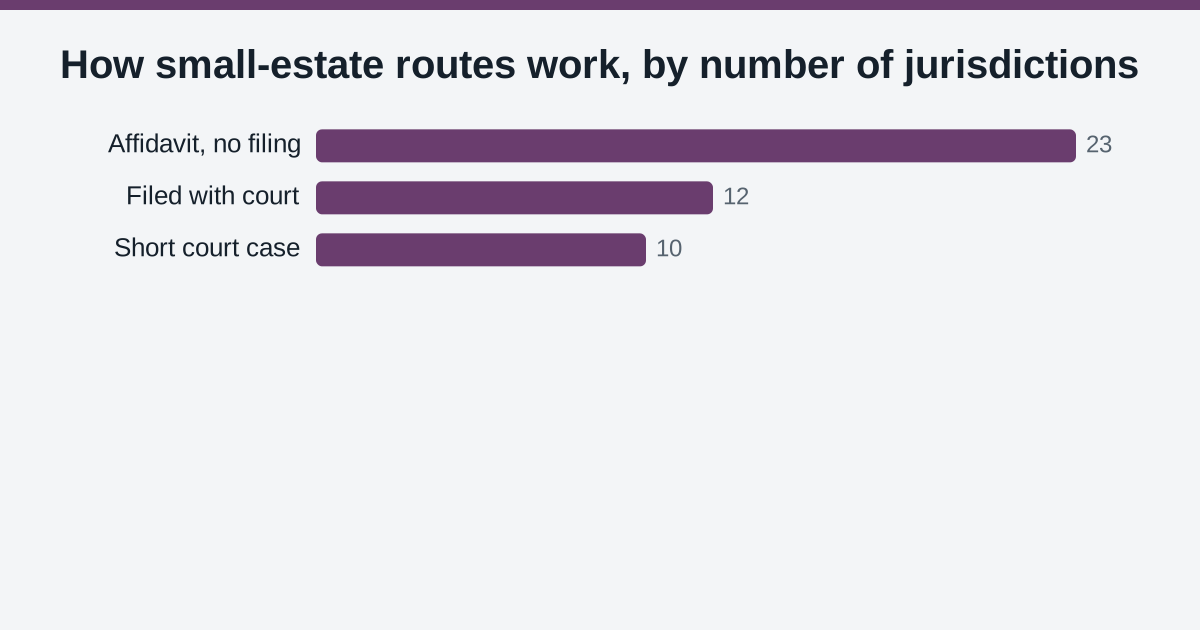
Of the 51 jurisdictions on this site, the simplified route works in one of three ways:
| Route | Jurisdictions | Examples |
|---|---|---|
| an affidavit handed to the bank or other holder, with no court filing | 27 | Alaska, Arizona, California, Colorado |
| an affidavit or sworn statement filed with the court or its clerk | 13 | Arkansas, Connecticut, Massachusetts, Missouri |
| a short court proceeding started by petition | 11 | Alabama, District of Columbia, Florida, Georgia |
Each is limited by a dollar figure in the statute (with three exceptions that have none) and by rules on what counts. The small estate limits page lists every figure with its citation.
A worked example of the cost
Take a $30,000 estate in New York. It is within the $50,000 limit for New York's small estate procedure (N.Y. Surr. Ct. Proc. Act § 1301). If it went through full administration instead, the court fee under N.Y. Surr. Ct. Proc. Act § 2402 would be $215, and creditors would have 7 months from the issue of letters (N.Y. Surr. Ct. Proc. Act § 1802).
The same estate in Massachusetts is over the $25,000 voluntary administration limit (M.G.L. c. 190B, § 3-1201), so it would normally need a probate petition; the Probate and Family Court's fee table puts that at $390 including the surcharge, and claims must be brought commenced within 1 year after the date of death of the deceased (M.G.L. c. 190B, § 3-803(a)).
How long it takes
No statute fixes the length of probate, but the creditor claim period sets a floor: an estate is rarely closed before it ends. Across the 39 jurisdictions with a claim period on this site the median is 122 days. The probate timelines work through the dates for each state.
Where to get help for free
The probate court in the county where the person lived is the official starting point. Most have a clerk's office or self-help center, published forms, and fee waiver rules for people who cannot pay. This site does not give legal advice or refer anyone to lawyers.
Sources
- N.Y. Surr. Ct. Proc. Act § 1301 and N.Y. Surr. Ct. Proc. Act § 2402: New York Senate, fee schedule, checked 2026-10-20.
- M.G.L. c. 190B, § 3-1201: Massachusetts Legislature; fees: Massachusetts Probate and Family Court filing fees, checked 2026-10-20.
- Every other figure: the statute linked on each state page; see the methodology.
Questions
What is probate in simple terms?
Probate is the court-supervised process that gives someone legal authority to collect a dead person's property, pay valid debts and pass what is left to the people entitled to it under the will or the state's intestacy law.
Does every estate go through probate?
No. Property with a named beneficiary or a surviving joint owner passes outside probate, and most states let a small estate use an affidavit or a short procedure instead of full administration.
Who pays the probate court fee?
The estate pays it, usually when the petition is filed. The person filing often advances it and is repaid from estate funds.